
Cookie Clicker
DashNet B.V.Simulation
4.54.74K Reviews
- Version
- 8
- Installs
- 5.00M
- Age Rating
- Everyone
Screenshots




Our Review of Cookie Clicker
 Analysis by Appyee
I went into Cookie Clicker expecting a tiny time-killer and found a game that is much more about planning than its playful premise suggests. The basic idea is simple: produce cookies, spend them on improvements, and let the bakery grow while you are away. What makes it interesting is the gradual change from tapping for progress to managing a self-running production system.
That change is also the key to deciding whether it belongs on your phone. If you want a simulation game that asks for constant attention, quick reactions, or a detailed story, this is probably the wrong direction. If you enjoy watching small choices compound over time, checking in briefly, and experimenting with the balance between immediate gains and long-term growth, I think it is one of the more approachable idle games to try.
What I considered before recommending it
My first decision criterion was how much active play the game really demands. Cookie Clicker can begin with direct interaction, but its appeal comes from building a cookie-making process that continues without every second being supervised. I could open it during a spare moment, make a few decisions, close it, and return later to see what had accumulated. That makes it very different from a conventional simulation where progress stops unless I am actively completing tasks.
The second criterion was whether the decisions felt meaningful. The game does not require complicated controls, yet choosing where to put the next batch of cookies matters. I had to decide when to strengthen the basic production rate, when to invest in something that would improve future growth, and when to hold back rather than spend everything immediately. Those choices are straightforward enough for a newcomer but give the numbers a sense of direction.
I also paid attention to how well the game works in short sessions. A good idle game should not punish me for putting it down. Here, the loop suits small breaks: I can check progress, buy an improvement, adjust my plan, and leave. It is especially comfortable for people who like games that sit alongside their day instead of demanding that the game become the day.
Another useful test is tolerance for repetition. The central activity remains focused on producing cookies, so the game does not constantly reinvent itself. Its variety comes from the growing scale of the bakery and the decisions connected to that growth. Players who need a new objective every few minutes may find this narrow. Players who like refining a system may find the repetition relaxing.
The practical details are friendly. It is a free simulation game from DashNet B.V., rated for Everyone, and it runs on Android devices using version 7.0 or later. The current version is 8, and the game has reached over five million installs with an average rating of 4.5 from around 38 thousand ratings. Those figures do not replace personal taste, but they do reflect how broadly this simple format has connected with players.
The opening is simple, but the loop changes character
At the beginning, the premise is almost deliberately plain. I start by making cookies and using that output to improve the bakery. The first interactions feel direct and slightly silly, which is part of the charm. There is no need to learn a complicated interface before seeing progress, so I understood the basic loop almost immediately.
After a while, the important question stops being “How do I make a cookie now?” and becomes “What will make the next stretch faster?” That shift gives the game its simulation character. I began thinking in terms of momentum, not individual taps. A purchase that seemed modest on its own could change how quickly the next purchase arrived, which encouraged me to consider sequences instead of isolated rewards.
One of the less obvious strengths is that the game creates a useful tension between visible progress and efficient progress. Spending as soon as I could gave me an immediate sense of movement, but waiting for a more valuable improvement could make the next phase smoother. I would not call the choices difficult, yet they gave me enough control to feel responsible for the shape of my bakery rather than merely watching an automatic counter.
Why the idle structure works in everyday use
My favorite way to use it was in short, repeated visits. Imagine waiting for a train, taking a break between tasks, or settling down before bed. I could open the game, see what had accumulated, make one or two purchases, and close it without feeling that I had abandoned an urgent mission. That is a realistic advantage over many simulation games that expect a longer uninterrupted session.
The same structure can also fit people who like a background hobby. I often prefer a game that gives me something to check without asking me to remember a large story or maintain a complicated schedule. Cookie Clicker provides that low-pressure routine. The bakery becomes a small ongoing project, and each return gives me a reason to consider whether my previous decision still makes sense.
There is a trade-off, though. Because the game is comfortable in the background, it can become something I open automatically rather than something I play with full attention. If I was looking for a focused evening activity, I sometimes found the loop too passive. Its strength is convenience, and convenience can also make the experience feel less substantial than a traditional management game.
Small planning habits that improve the experience
I found it helpful to avoid treating every available purchase as equally attractive. When I bought improvements without considering the next few steps, the bakery still advanced, but the process felt less deliberate. A better habit was to decide whether I wanted an immediate boost or a stronger foundation for later growth. That simple distinction made the progression more satisfying.
Another useful approach is to check the game at natural points in the day instead of constantly reopening it. The idle format already supports waiting, so there is little benefit in turning every spare second into a status check. I got more enjoyment from making a plan, leaving the game alone, and returning when I had enough accumulated progress to make a meaningful decision.
I also recommend treating resets or major progression changes, when they become relevant to your play, as planning moments rather than automatic buttons. The temptation in an idle game is to choose the option that produces an immediate sensation of advancement. I preferred asking what I would gain over the next several visits and whether the change matched the way I actually played. That made the long-term loop feel less random.
These habits are not required to enjoy the game, but they reveal why it lasts beyond the first joke. The deeper pleasure comes from recognizing patterns in your own play: whether you check often, whether you prefer steady improvement, and whether you enjoy saving for a larger turning point.
Where Cookie Clicker wins, and where another type of game may fit better
I find Cookie Clicker works best when I want relaxed, self-directed progress rather than a game that fills every spare minute. Its appeal is in making a small choice, stepping away, and returning with a new reason to plan; if you need richer interaction or a clear finish line, another kind of game may suit you better. The next section looks at how that trade-off affects its staying power.
Its strongest advantage is low-pressure progression
Cookie Clicker wins when I want a game that is easy to understand but still gives me room to optimize. It does not overwhelm me with a long tutorial or demand quick reflexes. The basic action is accessible, while the production decisions gradually create a more thoughtful routine. That combination makes it suitable for casual players who still want a sense of ownership over their progress.
It also wins as a mobile companion. I can fit it around other activities rather than rearranging my schedule around it. Many simulation games are rewarding precisely because they are detailed, but that detail can become work on a small screen. This game keeps the interaction light enough that I can enjoy it while commuting, waiting, or taking a short break.
The humor helps too. The cookie theme gives the numbers a memorable identity. Instead of managing an abstract factory, I am building an increasingly absurd bakery empire. That playful framing makes the repetition easier to accept, especially during the early phase when the available choices are still limited.
Its scale is another strength. The game starts with a small idea and lets that idea expand. I enjoyed seeing how a basic act of production could become a broader management problem without requiring me to learn a completely different game. The sense of escalation is more important here than visual spectacle or narrative drama.
What may frustrate you
The biggest limitation is that the central loop remains narrow. If you dislike incremental counters, repeated purchases, and gradual gains, the cookie theme will not hide that for long. There is no clever strategy that transforms the game into an action title. The experience asks you to appreciate accumulation, and that is a specific taste.
I also noticed that the game can make progress feel less exciting after the novelty wears off. Early improvements are easy to understand because each one visibly changes the pace. Later, the satisfaction depends more on long-term planning and patience. Some players will enjoy that slower rhythm; others may feel that they are checking a spreadsheet with a humorous skin.
The free price makes it easy to try, but “free” does not mean the game will suit every player. The real cost can be attention. An idle game can encourage frequent checking, and anyone who is trying to reduce habitual phone use should be honest about whether another progress loop is helpful. I would not recommend it to someone who already feels overloaded by notifications and unfinished digital tasks.
It is also not my first choice for someone seeking a rich management simulation. A more detailed alternative in the simulation category may be better if you want complex layouts, resource chains, staff decisions, or a strong sense of direct control. Cookie Clicker is intentionally lighter. Choosing it means accepting that its depth comes from progression decisions, not from a large set of hands-on systems.
On the other hand, a conventional casual game may be a better fit if you want clear beginnings and endings. Cookie Clicker is designed around continuation. There is always a reason to return, but that can make the experience feel open-ended rather than complete. I enjoyed that quality, although I understand why some players prefer a self-contained level, puzzle, or campaign.
Who should make the switch, and who should stay with an alternative?
I would recommend switching to this game if your current mobile games demand too much concentration and you want something calmer. It is particularly suitable for people who like watching a system grow, making occasional choices, and returning to a familiar project. It can also work for newcomers to idle games because the premise is immediately understandable.
I would stay with a more active simulation if your enjoyment comes from controlling every stage of a process. If you want to place objects precisely, respond to changing conditions, or solve problems through direct intervention, the lighter structure here may feel empty. The game is not trying to compete on those terms.
Players who prefer story should also look elsewhere. The cookie premise supplies personality, but I did not play it for character development or a narrative arc. Likewise, people who need competitive matches, social coordination, or fast rounds will probably get more satisfaction from another category entirely.
The cost of switching is low because the game is free and the basic concept is easy to grasp. The more important adjustment is psychological: I had to stop expecting a conventional objective and accept that progress itself is the activity. Once I made that change, the game became much more enjoyable. Without it, the repeated cycle can seem pointless.
How to decide after the first few sessions
Give the game enough time to move past the first novelty, then ask yourself what you are enjoying. If you like choosing between immediate output and future efficiency, you are probably responding to its strongest feature. If you are only waiting for the game to become more active, that change is unlikely to arrive in the way you want.
It is also worth noticing how you use idle progress. Do you enjoy returning to a larger total, or do you feel that the game played itself while you were away? That answer matters more than the theme. Some players experience offline-style progress as a reward; others find it removes the satisfaction of doing the work themselves.
For me, the best use is as a small routine rather than a primary game. I can keep it available for brief visits and play something else when I want challenge, story, or direct control. That combination avoids asking Cookie Clicker to provide experiences it was never designed to deliver.
My recommendation for Android players
Cookie Clicker is worth trying if you enjoy patient, incremental simulation with a playful surface and very little pressure. I like that it turns a single silly action into a surprisingly absorbing exercise in timing, saving, and long-term thinking. The free entry point and Everyone rating make it easy to explore, while support for Android 7.0 or later covers many older devices.
I would not call it universally compelling. Its repetition, open-ended progression, and passive rhythm can be genuine drawbacks, especially for players who want constant interaction or a defined ending. A more hands-on simulation is the better choice when you want to manage detailed systems directly, and a story-driven or action-focused game will serve you better when you need variety.
For my own play, the deciding factor is how little friction it creates. I can start without preparation, leave without losing the thread, and return to a bakery that has continued developing. That makes it an unusually convenient companion game. The trick is to play it intentionally: set a simple plan, check in when convenient, and do not confuse a larger number with a better decision.
DashNet B.V. has built a game around a very small premise, but the result is more thoughtful than the premise first suggests. I recommend it to anyone curious about idle simulation games who wants a gentle introduction to the format. Just know what you are choosing: not a fast adventure or a detailed business simulator, but a patient loop where the pleasure comes from turning tiny improvements into a bakery that keeps growing.
Verdict
Strengths of Cookie Clicker
- Simple gameplay that is easy to understand within minutes.
- Runs well on most modern Android and iOS devices.
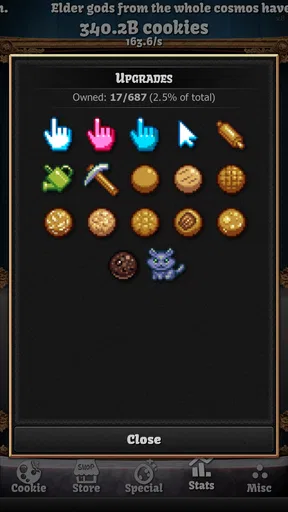
- Many upgrades provide short- and long-term goals.
- Offline progress lets your bakery grow while you are away.
- Distinct achievements reward experimentation and continued play.
Limitations of Cookie Clicker
- The repetitive clicking loop may become boring over time.
- Progress can feel slow without frequent upgrades or active play.
- The interface can become cluttered as systems and upgrades expand.
- Some features are easier to manage on larger screens.
- Long-term play requires patience because later milestones take time.
Other Releases by DashNet B.V.
View All
Cookie Clicker (ad-less)
Simulation4.4
Similar Picks in This Category
View All
Truckers of Europe 3
Wanda Software4.3

Town Building Life Simulator
XGame Global4.2

Fidget Toys Trading・Pop It 3D
Freeplay Inc4.7

Sculpt People
CrazyLabs LTD4.4

Scary Teacher 3D
Z & K Games4.2

Hair Tattoo: Barber Shop Game
CASUAL AZUR GAMES4.3
Frequently Asked Questions
What is Cookie Clicker and how does the game work?
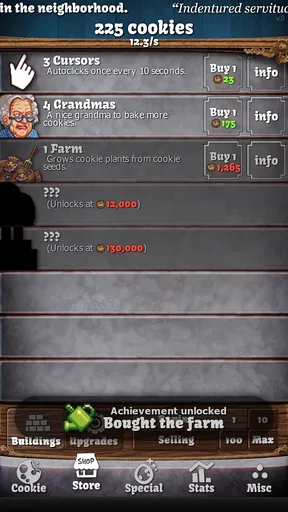
Cookie Clicker is an incremental idle game focused on producing as many cookies as possible. You begin by clicking a large cookie, then spend your earnings on cursors, buildings, upgrades, and special boosts that automate production. As your cookie empire grows, progress becomes increasingly passive, although occasional decisions and timed events can significantly improve your results.
Can Cookie Clicker be played offline or without an internet connection?
Cookie Clicker is primarily designed as a single-player experience and can generally be enjoyed without a constant internet connection, especially after the game has loaded. Offline progress may depend on the version and platform you use, so it is wise to open the app periodically and save your progress. Features such as updates, advertisements, cloud synchronization, or external links may require internet access.
Is Cookie Clicker free to download and play?
Cookie Clicker can be available as a free download depending on the Android, iOS, or browser version, but availability and monetization may differ between platforms. Some editions may include optional purchases, advertisements, or paid features, while others offer a more straightforward premium experience. Before installing, check the official store listing for the current price, in-app purchase details, and supported devices.
Does Cookie Clicker contain advertisements or in-app purchases?
The presence of advertisements and in-app purchases depends on the specific Cookie Clicker version and the store from which it is downloaded. The core gameplay is usually centered on earning cookies rather than paying to progress, but certain editions may offer optional purchases or promotional elements. Review the app’s store description and permissions before downloading, particularly if you prefer an ad-free experience.
Will I lose my progress if I uninstall Cookie Clicker or change devices?
Progress protection depends on the version of Cookie Clicker you are using and whether it supports cloud saving, account synchronization, or manual save export. Uninstalling the app can remove locally stored data, so you should look for a save, backup, or synchronization option before deleting it. When moving to another device, confirm that your progress has successfully synced before resetting or replacing the original device.
Play our best games!


